 Map
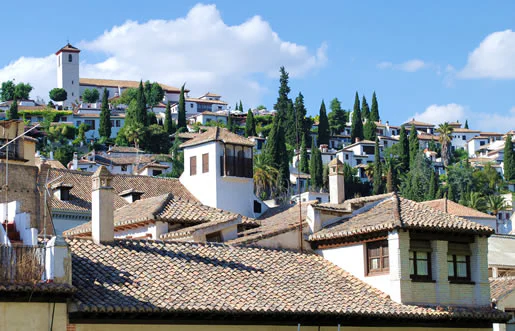
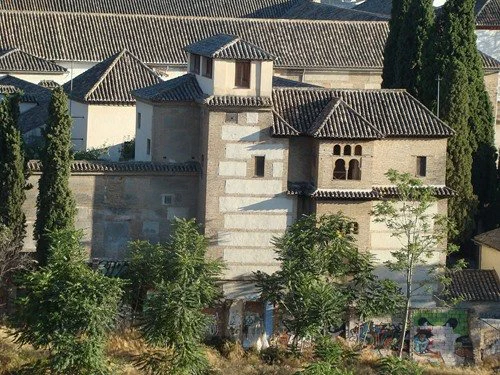
MapIn the very heart of the Albaicín, the Dar al-Horra Palace rises as one of the few surviving examples of Andalusi domestic architecture in Granada. Its name, meaning “House of the Honest Woman”, refers to Aixa al-Horra, mother of the last sultan of Granada, Boabdil, who lived here after being repudiated by Muley Hacén.
The palace stands within the ancient Alcazaba Qadima, the first fortified nucleus of the Albaicín. Some research suggests that this residence may originally have been part of the palace of the Zirid sultan Badis, which would extend its origins back to the 11th and 12th centuries.
Behind its sober and almost anonymous exterior, visitors discover a delicate and elegant interior, a perfect example of Nasrid courtly life. Today, the Dar al-Horra Palace is an open window onto the everyday splendour of the last Muslim kingdom on the Iberian Peninsula.
History of the Monument
The Dar al-Horra Palace was built in the 15th century. Aixa al-Horra, the legitimate wife of Muley Hacén, came to reside here after being repudiated by the sultan in favour of the Christian slave Isabel de Solís, who converted to Islam under the name Zoraya. This situation sparked an internal conflict that marked the final period of the kingdom. While Muley Hacén settled in the Alhambra with his new wife, Aixa and Boabdil were pushed aside and eventually moved to the Albaicín, where they enjoyed strong popular support.
The strategic position of the building, located in the highest part of the neighbourhood, allowed it to dominate the city visually, control the roads leading into Granada, and observe the towers and palaces of the Alhambra. This vantage point proved invaluable during a period of growing political tension.
The people of Granada viewed Zoraya with suspicion, as the Christian-born favourite of Muley Hacén. For many, it was unthinkable that a woman of Christian origin could acquire such influence within the Nasrid court, especially if it jeopardised Boabdil’s rights to the throne. His mother, Aixa al-Horra, was determined not to allow Zoraya’s children to displace her own son.
Resolved to defend Boabdil’s legitimacy, Aixa forged an alliance with the powerful Abencerraje family, one of the leading aristocratic factions in the kingdom. From her residence in Dar al-Horra, she promoted opposition to Muley Hacén, fuelling the growing tension that would culminate in a full conspiracy against the sultan.
As a result, in 1482, the situation erupted. Part of the nobility proclaimed Boabdil as sultan in the Albaicín, openly challenging Muley Hacén’s authority. The sultan reacted immediately: he ordered his son’s arrest and had him imprisoned in the dungeons of the Alhambra.
Boabdil’s capture intensified the revolt. Supporters of Aixa and the Abencerrajes rose up against Muley Hacén, eventually forcing him to retreat to Málaga and other territories under his control. The uprising achieved its aim: Boabdil was recognised as sultan by a significant portion of the kingdom, although his authority existed alongside that of his father and, later, that of his uncle, El Zagal.
This conflict between rival factions marked the beginning of a prolonged civil war that fractured the Nasrid kingdom at its most critical moment. Internal division fatally weakened Granada just as the Castilian offensive was gaining strength, hastening the downfall of the last Muslim kingdom on the Iberian Peninsula.
After the conquest of Granada by the Catholic Monarchs in 1492, the palace was granted to their secretary, Hernando de Zafra.
Later, in 1507, Queen Isabella founded the Monastery of Santa Isabel la Real, which was entrusted to the Poor Clares. The palace was incorporated into the convent complex, undergoing several modifications that nonetheless preserved much of its original Nasrid structure.
Unlike many other convents that were expropriated during the Mendizábal Disentailment of 1835, Santa Isabel la Real not only retained its assets but expanded its holdings with property from other religious institutions.
The historical significance of Dar al-Horra was finally acknowledged in 1922, when it was declared a historic-artistic monument. Its restoration began in 1931 under the architect of the Alhambra, Leopoldo Torres Balbás, who undertook the first works to recover its sober yet elegant original appearance, a process continued by other architects throughout the 20th century, resulting in the palace we see today.
Description of the Monument
Despite the adaptations made for convent life, the Dar al-Horra Palace preserves much of its original structure and the elegance of its Nasrid decorative elements. It is a typical Nasrid house, closely aligned with the architectural style of the Alhambra, and it later served as an inspirational model for the Morisco houses of the Albaicín.
The plasterwork inscriptions in the mirador reveal the private character of this residence. They contain phrases such as “Blessing”, “Happiness”, “Health is everlasting” and “Joy continues”.
The palace is organised around a rectangular courtyard with a north–south oriented pool. The north and south porticoes open with three horseshoe arches supported by columns, the central arch being the largest. The wooden ceilings of these porticoes are flat and decorated with geometric motifs. Behind the arcaded galleries lie the principal rooms, characterised by their high ceilings. The southern room was used as the convent’s chapel before the construction of the current church of Santa Isabel la Real.
The upper floor of the palace still retains the essence of a Nasrid home, and from here you can enjoy impressive views of the barrio de Axares, the Church of San Cristóbal (once the site of the former mosque) and the Zirid wall.
The palace also features a small orchard irrigated by water from the Aynadamar canal, which comes from the Aljibe del Rey. This hydraulic system, one of the oldest and most emblematic in Granada, links the palace to the living history of water in the city and to the ingenious urban planning of the Nasrid period.
Useful Information for Visitors
Opening hours:
From 15 September to 30 April: Monday to Sunday, from 10:00 to 17:00.
From 1 May to 14 September: Monday to Sunday, from 9:00 to 14:30 and from 17:00 to 20:30.
There are two types of tickets available:
- “Andalusí Monuments” ticket, which includes entry to the Dar al-Horra Palace, the Corral del Carbón, the Maristán, and the Morisco House Horno de Oro (C/ Horno de Oro).
- “Dobla de Oro” ticket, which provides access to the Andalusí monuments of Granada: the Bañuelo, the Corral del Carbón, the Maristán, the Morisco Houses (Horno de Oro, Casa de Zafra and Casa del Chapiz), the Qubba of the Cuarto Real de Santo Domingo, the Dar al-Horra Palace, and the “Alhambra General” ticket.
Entry to the Alhambra is subject to the timed access to the Nasrid Palaces, just like the General Alhambra ticket. This schedule is strict, does not allow delays, and visitors must present the same identity document or passport used to purchase the ticket.
For more detailed information, it is recommended to check the official websites of the monuments.
How to Get There
On foot
Walking is the easiest and most convenient way to reach the monument. From the city centre, it takes around 20 to 25 minutes via Reyes Católicos and Gran Vía, or along Cárcel Baja Street. If your starting point is Plaza Nueva, the quickest routes are along Calle Cruz de Quirós, Cuesta de San Gregorio, or Calle Elvira.
By car
Due to traffic restrictions in the Albaicín and the narrow layout of its streets, the best option is to access via the Carretera de Murcia. You can park in the San Cristóbal Albaicín car park, next to the Ave María San Cristóbal school, or in nearby free parking areas. From there, the walk to the monument takes around 9 to 10 minutes.
By bus or taxi
Two bus lines depart from Plaza Nueva: C31 and C32. You should get off at Plaza de San Nicolás and walk a few minutes to the monument.
A taxi is also a comfortable option, though the fare will depend on your starting point and the time of day.
Where to Eat
In the Albaicín neighbourhood, close to the Dar al-Horra Palace, you’ll find some of the most popular places to try Spanish cuisine and typical dishes from Granada. In the Placeta de San Miguel you’ll find Mesón El Yunque, perfect for enjoying tapas and dishes on its terrace, such as snails, plato alpujarreño, oxtail or fried fish. In Plaza Larga you will come across Restaurante Los Nazaríes. On Pagés Street you’ll find Restaurante Casa Torcuato, specialising in fried fish and local wines since 1932. Very close by is Bar la Entraiya, known for its traditional tapas and dishes such as snails or fried fish. On the same street stands Casa Gabriel, specialists in grilled cuisine. Also nearby is Bar Aliatar Los Caracoles, ideal for enjoying tapas and dishes like snails in sauce or aubergines with honey on its spacious terrace.
We recommend checking opening times, availability and recent reviews before your visit.
What to See Near the Dar al-Horra Palace
Thanks to its location, the first natural visit beside the Palace is the Monastery of Santa Isabel la Real (Monasterio de Santa Isabel la Real), founded in the 16th century and one of the most remarkable monastic complexes in the Albaicín.
In Plaza de San Nicolás you will find the famous church and San Nicolás Viewpoint (Mirador de San Nicolás), an essential spot for enjoying one of the most iconic views of the Alhambra. Close to the square is the Carmen de los Geranios – Casa Museo Max Moreau, an intimate and charming cultural space.
Another nearby viewpoint is San Cristóbal, from where you can see the Zirid wall of the ancient Alcazaba Qadima, the Dar al-Horra Palace in the foreground, and the Alhambra, the Albaicín and the city of Granada.
As you continue exploring the Albaicín’s narrow streets, you will come across corners full of authenticity, such as the Carvajales Square (Placeta de Carvajales) —with another beautiful view of the Alhambra—, the Church of San Juan de los Reyes, or historic places such as the Aljibe del Rey and its Carmen. The Aljibe del Rey is one of the oldest water reservoirs in the city.
If you head towards the Lower Albaicín, you can walk down the Cuesta del Chapiz to the Paseo de los Tristes and the Carrera del Darro. In this area you can visit monuments such as the Maristán (the former Nasrid hospital) or the Bañuelo. If you make your way towards the city centre via Calle Elvira, you will find important landmarks such as the Monaita Gate (Puerta de Monaita) and the Elvira Gate (Puerta de Elvira).
Continuing into the centre, you should not miss places such as Plaza Nueva and the Royal Chancery, the Cathedral of Granada and the Royal Chapel, Plaza Bib-Rambla, the Corral del Carbón, among many other monuments and sites in the area.