Origins of Granada
The origins of the city of Granada are shrouded in mystery. Many of its spots tell the story of legends and fables, which have turned it into a magic city. The most incredible theories have been elaborated, finding the origins of Granada in the biblical Noah, in Hercules or in different Mediterranean civilisations of the antiquity.
Some truth has been found among all these theories: the city of Granada was founded by the Iberian tribe of the Turdulos, one of the most civilised tribes among the first inhabitants of the Iberian Peninsula. This tribe founded the city with the name of Ihverir, which later became Iliberis with the Romans.
The Romans conquered Ihverir later on and transformed it into a municipality (1st and 2nd centuries BC). It then received two different names: the Iberian name, Iliberis, and the Latin name, Florentia, which according to Antonio Gallego y Burín's interpretation in Guía artística e histórica de Granada [Artistic and historical guide of Granada] means "city full of flowers or fruits".
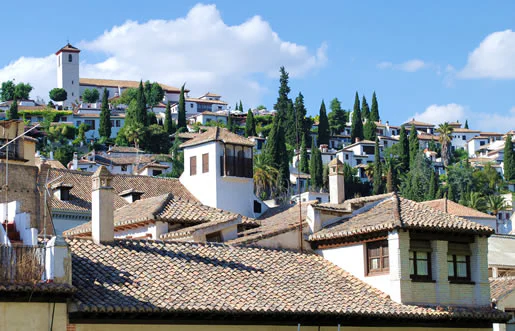
This Roman settlement was established on the current neighbourhoods of the Alcazaba and the Albaicin and covered all the area up to the hill of the Alhambra.
No documents have been kept about the population or the traditions of the Visigothic period, although some coins and medals have been found. This fact has lead scientists to believe that Granada was the capital city of the province even after the Roman period, especially because the Barbarian invasion increased the city's military power and reduced the importance of other settlements of the Empire. Iliberis shared the site with Granata, which was not an independent settlement but rather a neighbourhood at the border of the Alcazaba of Iliberis, inhabited by Jews.
The invasion of the Iberian Peninsula by the Muslims started in the year 711, when Tariq arrived to the cost of Tarifa (near Gibraltar). In the year 745 a detachment of the Muslim army from Damascus, which had intervened in the conquest of the Iberian Peninsula, was lagging behind and decided to go to Cordoba in order to demand the plunder that had been promised to them. But when they finally got there, the plunder had already been shared and the Cordovan authorities had to offer them in compensation a place located in the foothills of the faraway mountains. The Syrians had no alternative but to accept, but they could not imagine what this decision, taken with so little enthusiasm, would turn out to be after some time.
Iliberis became Elvira for the Muslims, and it was destroyed in the year 1010. Its inhabitants started to move to the Albaicin. Zawi ben Ziri was the founder of the Ziri dynasty, which made Granada become an independent kingdom in 1013. This dynasty reigned until 1238, when Muhammad Ibn Yusuf Ibn Nasr, also known as Ibn al-Ahmar, founded a new dynasty, the Nasrid dynasty. This dynasty conquered Granada once again, built the Alhambra and reigned until January 2nd 1492, when the troops of the Catholic Monarchs conquered the last Muslim city in the Iberian Peninsula and Boabdil, the last Nasrid king, surrendered.
Read more about...


Hotels in Granada