How to get to the Alhambra
When visiting the Alhambra you may choose among several means of transport. You should always take into account that the monument is located on top of a hill. The different ways to get to the Alhambra will be now explained, but we strongly recommend you going on foot in order to enjoy the natural and artistic aspects of the surroundings, which can be unnoticed if you take other means of transport.
On foot
(Average distance: 800 m. and a slope between 6% and 23%).
There are two different paths to get to the Alhambra on foot from the city centre. The most beautifully and historically interesting of them is the one, which starts in the street Cuesta de Gomérez from Plaza Nueva. (Distance from Plaza Nueva to the Access Pavillon: 1.150m)
The Gate of the Pomegranates (Puerta de las Granadas) is the first monument that you will see and it is the beginning of the tree-lined avenues of the Alhambra. Pedro Machuca built this gate under the orders of Charles V around the year 1536 on the «Bib al-Buxar» or «gate of the glad tidings», a defensive tower which was one of the gates of the city. This gate leads to the tree-lined avenues of the Alhambra and to the walled enclosure.
Once you are on the other side of this gate, you will be walking along the tree-lined avenues of the Alhambra, which was a poplar grove during the Christian period, whose appearance has been modified over the years. These current tree-lined avenues are the result of the redesign carried out in the 19th century.
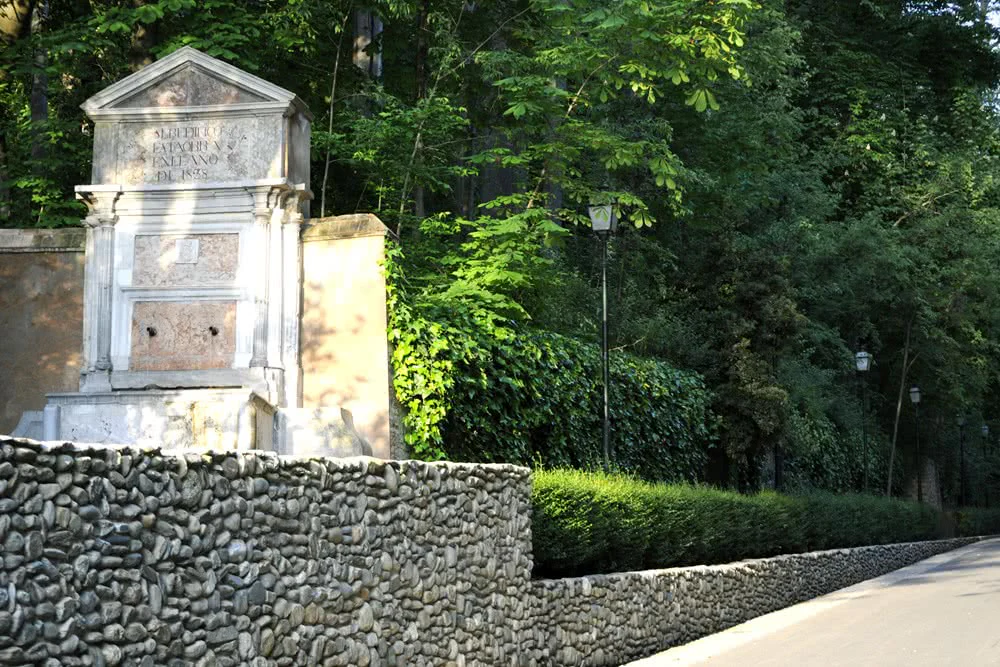
Next to the esplanade of the Justice Gate (Puerta de la Justicia), which is the entrance to the complex of the Alhambra, you will find on the left side the Charles V Pillar. It is a three-spout fountain built by Pedro Machuca under the orders of the Count of Tendilla in the 16th century and was restored in the 17th century by the local architect Alonso de Mena.
It is also possible to get to the Alhambra on foot via Cuesta del Rey Chico, which means the Little King's Slope, so called in honour of the last Nasrid king, Boabdil «el Chico» («the Little King»). This street is popularly known as Cuesta de los Chinos, or Pebble Slope, because of its paving. (Distance from Paseo de los Tristes to the Access Pavillon: 860 m)
This street starts from the left bank of the river Darro, at the end of the Paseo del Padre Manjón, popularly called the «Paseo de los Tristes», which means Sad People's Avenue, as it was part of the road that the funeral processions took to the old cemetery. The slope goes along the fortress and comes to an end at the Mimbre, next to Fuentepeña (Generalife's esplanade).
This second path is less interesting from an historical and artistic point of view, but it is instead a very romantic walk and a more pleasant way to go down to the city after visiting the Alhambra, between the walls of the citadel and the hill's vegetation.
Using public transport
Bus route C30 Alhambra - Centro
- Timetable: https://www.transportesrober.com/transportes/horn.php?ln=C30
- Map: https://www.transportesrober.com/images/itin/LC30.jpg
Bus route C32 Alhambra - Albaicín
- Timetable: https://www.transportesrober.com/transportes/horn.php?ln=C32
- Map: https://www.transportesrober.com/images/itin/LC32.jpg
Bus route C35 Cementerio - Barranco del Abogado - Centro
- Timetable: https://www.transportesrober.com/transportes/horn.php?ln=C35
- Map: https://www.transportesrober.com/images/itin/LC35.jpg
- Alhambra bus stop: Paseo de la Sabica, 38 - Parque Alixares
All routes
- Timetable: https://www.transportesrober.com/transportes/linhor.htm
- Map: https://www.transportesrober.com/transportes/lineas.htm
Taking a taxi is another option to go to the Alhambra (Telephone: 958 280 654).
By car
Private transport is not allowed to access to the Alhambra from the city center.
From road N-323 / A-44, take the ring road Ronda Sur (A-395) and follow the signs towards the Alhambra.
Once you get to the Serrallo tunnel, use the left lane and take the exit 5A. On the roundabout, you should turn left and continue up Avenida Santa María de la Alhambra. Then go straight Camino Viejo del Cementerio where you will find signs indicating the location of the parking areas, located a few meters away from the ticket office and the main entrance of the Alhambra.
Get driving directions in Google Maps
In the Facilities and Access sections of our interactive map you can find the locations of the parking lots, bus and taxi stops, main entrances, access on foot and bus tours.
Read more about...

Hotels in Granada